
Riprap on Smith Lake, Alabama: Rules, Stone and Cost
Riprap is the shoreline fix Alabama Power names first on Smith Lake, ahead of seawalls. This guide covers what Alabama Power's Smith Lake guidelines actually say about riprap, the permit and its fees, the Army Corps limits that ride along with it, the extra rock and planting rules on turtle-habitat shorelines, when the work can happen, and what riprap may cost.
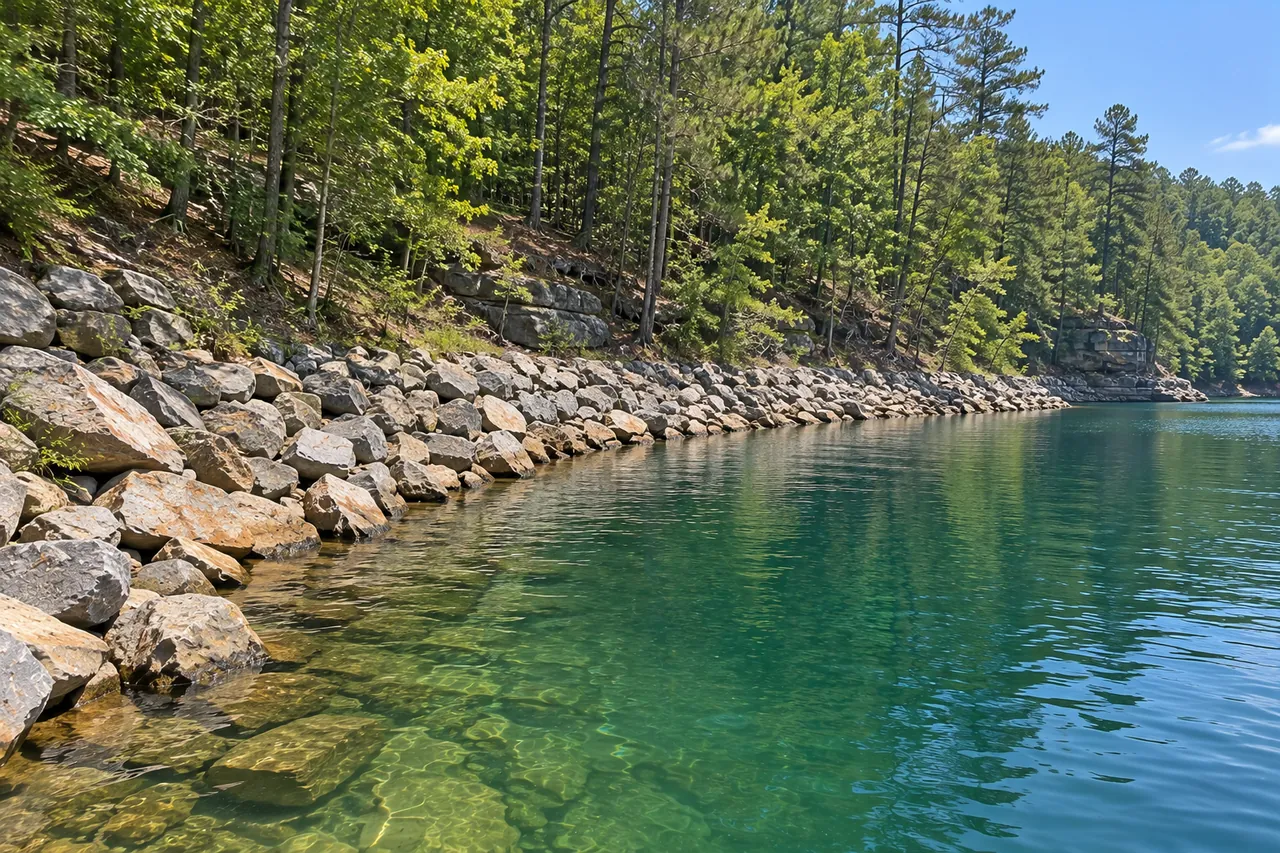
What riprap is, and what it has to do
Riprap is a blanket of large, angular stone laid over a bank that's losing soil to the water. Waves and boat wakes break on the rock rather than on dirt, and the gaps between stones soak up some of that energy instead of throwing it back at the bank. Angular stone locks together better than rounded stone, which is why quarried rock is the usual material.
A riprap bank has three working parts. The toe is the bottom edge, set into the lakebed so the stone can't slide out from under itself. The filter is a layer under the rock, either graded stone and sand or a filter fabric, that lets water drain out of the bank without carrying soil through the gaps. The armor layer is the visible stone on top. When riprap fails, the cause is often one of those three: the toe was scoured out, soil washed out through a missing filter, or the stone was too small or too thin for the waves it faces.
Smith Lake adds its own wrinkle. Alabama Power holds the lake near 510 feet in summer and lowers it toward a winter pool near 496 feet, so the water meets the bank at a range of heights over a year. A bank that looks sound at full pool can be undercut lower down, where you only see it in winter. The winter drawdown page covers what that low water exposes.
Alabama Power's bank stabilization rule, word for word
The rule that governs riprap on Smith Lake is a single paragraph in Alabama Power's "General Guidelines for Residential Shoreline Permitting & Permit Terms and Conditions" for Smith Lake (FERC Project No. 2165), revised July 15, 2025:
"BANK STABILIZATION: Rip-rap and natural bank stabilization are the preferred methods of erosion control; however, potential use of seawalls will be evaluated on a case-by-case basis. Approved seawalls should be constructed as close to the existing shoreline as possible for the purpose of preventing erosion of the shoreline bank. The source and kind of backfill must be approved by Alabama Power in its sole discretion. Backfill may be placed only to the contour of the natural slope of the property. No debris or foreign materials may be used as backfill. No new creosote products may be used. Rip-rap may be required at the toe of all new and reconstructed seawalls two feet above the lakebed and two feet out from the bottom of the seawall."
Alabama Power, Smith Lake guidelines, revised July 15, 2025
Read sentence by sentence, it tells you four things about a riprap job:
- Riprap is the default. Alabama Power puts riprap and natural stabilization ahead of seawalls, which it weighs one site at a time.
- Fill is controlled. If the bank needs soil or stone behind it to reshape the slope, Alabama Power approves where that material comes from and what it is, and it can't build the lot out past the natural slope.
- No junk in the bank. Debris and foreign material can't be used as backfill, and new creosote-treated wood isn't allowed.
- Walls get riprap too. A new or rebuilt seawall may be required to have riprap at its base, two feet up from the lakebed and two feet out from the wall. More on that on the seawalls page.
Where Alabama Power's control begins
The cover of the Smith Lake guidelines lists the lake's full summer level as the 510-foot mean sea level contour, Alabama Power's fee ownership at 510 feet, and its flood easement at 522 feet. In plain terms, Alabama Power owns the land below the 510-foot line, and it holds rights over the strip between 510 and 522 feet even where that strip is part of your lot.
Alabama Power's permits page says that if you "wish to repair, build or modify anything in either the lakebed or the Alabama Power Flood easement," you will need a permit, and it lists only painting and pressure washing as work that doesn't. Riprap sits right at the waterline, so it falls inside that line on essentially every lot.
The Alabama Power permit: fees and paperwork
The guidelines set non-refundable fees by type of work. For riprap, two of them matter most:
- General Construction Fee, $400. For new residential shoreline construction, which is where new riprap falls. If a job extends riprap along more of your shoreline, expect it to be treated as new construction and confirm with the shoreline office.
- General Repair Fee, $200. For repair "of a substantial degree," which the guidelines say includes "adding rip rap to an existing rip rap footprint." Alabama Power decides what counts as substantial.
- Permit Modification Fee, $100. For changes to a permit you've already applied for.
Work done without a permit costs more: $600 for unauthorized construction and $400 for an unauthorized repair, and the guidelines also list an $800 non-compliance fee. The permit guide lists every fee.
The guidelines' initial steps ask the property owner for a signed copy of the guidelines, a copy of the current deed (or the lease), a current survey where Alabama Power decides it needs one, your contact information, the name and contact information of any contractor you authorize, a sketch of all existing and proposed shoreline structures, and anything else Alabama Power requires. The application goes in on Alabama Power's shoreline website or in the APC Shorelines app, and Alabama Power is clear that submitting the form "does not constitute the issuance of a permit."
Plan for the review to take a while. Alabama Power says its staff make as many as two to three site visits per permit and that the process "can take up to 30 days or more depending on the required reviews." Once the permit is issued, the guidelines give you one year to complete the work.
The Army Corps side: APCO-PGP-05
Placing stone in the lake is also regulated by the U.S. Army Corps of Engineers. For Alabama Power reservoirs in the Coosa, Tallapoosa and Black Warrior basins, Smith Lake included, the Corps' Mobile District uses a set of programmatic general permits. The one for riprap is APCO-PGP-05, "Riprap for Shoreline, Bank, and Channel Protection; Bulkheads and Other Standard Shoreline Protection/Stabilization Devices Roughly Paralleling, and at the Shoreline or Bank."
Three parts of it shape a riprap job:
- A verification comes first. "A project specific verification must be obtained for all activities covered under the Alabama Power Company Programmatic General Permits (APCO-PGP) prior to the start of regulated activities," and requests "should be initiated via the APCO website at www.apcshorelines.com."
- Fill below the waterline is capped. The bedding fill below the ordinary high-water mark "may not exceed an average of one (1) cubic yard per linear foot of area being protected; however, there is no limit to the amount of riprap which may be placed above the ordinary high-water mark."
- Filter fabric may be required. "Use of appropriate filter fabric shall be considered and may be required by the local authorities."
The same permit says "No wetlands may be filled," and it doesn't cover groins, jetties or other solid structures built out from the shore. The programmatic permits took effect January 10, 2022 and are currently set to expire January 9, 2027. The document also notes that the state water-quality certification from ADEM that goes with them expires November 16, 2026 unless extended. Confirm with Alabama Power that both are current before your job is scheduled.
If your shoreline is turtle habitat, the rules change
Smith Lake is home to the flattened musk turtle, a federally threatened species that Alabama Power says is found nowhere else but in the upper Black Warrior River watershed. On shorelines Alabama Power has identified as potential habitat, conventional riprap and seawalls give way to enhanced natural stabilization (ENS), a mix of native rock, logs and native plants, built only between November 1 and March 31.
Alabama Power's ENS contractor's guide spells out a minimum rock mix of "45 percent of Class 1, 35 percent of Class 2, 15 percent of Class 3 and 5 percent of Class 5," calls for native trees and shrubs at "a 15 percent minimum cover rate," and applies "where eroded bank exceed a 50 percent slope – 2 horizontal (H) feet to 1 vertical (V) foot." Which shorelines are habitat isn't published, so ask the Smith Lake Shoreline Management Office (205-384-7385) before you design anything. The turtle-habitat guide goes through the ENS method in full.
Stone, slope and layers: what's published and what isn't
For ordinary riprap outside turtle habitat, the Smith Lake guidelines don't publish a stone size, a maximum slope or a layer thickness. Those details get settled between your contractor and Alabama Power during the permit review, and they should be written into your contract.
The ENS guide is the one place Alabama Power writes out rock construction step by step for Smith Lake, and its details show the level of care it expects in habitat areas:
- A trench at the toe of the bank "at least as deep as Class 1 rock."
- A 6-inch layer of sand and crushed stone as a filter, with crushed stone from 0.08 to 3 inches and washed, not unwashed.
- A rock layer "at least twice as thick as the average rock diameter."
- Rock that stops no more than 2 feet above the normal high-water line, which the guide places at 510 feet.
- Stone bought from a quarry or gravel pit. The guide says "Do not take them from the shoreline" or from below the normal high-water line.
Those numbers are written for habitat shorelines, so don't assume they apply to yours. They're still a fair checklist of what to ask a contractor about: how deep the toe goes, what sits under the stone, how thick the stone layer is and where the rock comes from.
When riprap can go in
On turtle-habitat shorelines, construction is limited to November 1 through March 31. Outside habitat, neither the Smith Lake guidelines nor the Corps permit we reviewed sets a calendar window for riprap; the Corps only encourages in-water work during periods of low flow.
In practice, winter is when most of the bank is out of the water. Alabama Power lowers Smith Lake late in the fall, holds it near winter pool through the winter, and brings it back up to summer pool in spring. With a review that can take 30 days or more, an application that goes in during late summer or early fall has the best chance of being approved before the lake is at its lowest. That's a planning suggestion, not a rule.
How a riprap job usually runs
- Ask about habitat first. Call the Smith Lake Shoreline Management Office and ask whether your shoreline is identified as potential flattened musk turtle habitat. The answer decides the method and the season.
- Get the bank looked at. A contractor measures the eroding length, looks at the toe at today's water level, checks how equipment will reach the shore (by barge or over land), and sketches what's there and what's proposed.
- Apply. You sign the guidelines and send the deed, sketch and contractor details through Alabama Power's site or app, along with any subdivision ARC or HOA approvals. Your contractor can be named as your agent, but the guidelines are written for the property owner as Permittee.
- Review. Alabama Power reviews the request, including the environmental review, and visits the site. Ask how the Corps verification is being handled for your job.
- Build. Once the permit is issued and the fee is paid, the work has to be completed within one year, and in habitat areas, inside the winter window.
Questions to ask before you sign
- Has anyone checked with Alabama Power whether my shoreline is turtle habitat?
- Who prepares and submits the permit application, and is the fee in your price?
- Will you work from a barge or from land, and what will that do to my yard?
- What size stone, what mix, and from which quarry?
- Will there be filter fabric or a stone filter under the rock?
- How deep will the toe be set, and how far up the bank will the stone go?
- If there's an old wall, does it stay, get riprap at its base, or come out?
- Is all of that in a written contract, with your license number if Alabama law requires one? Who does the work covers Alabama's licensing thresholds.
What riprap may cost on Smith Lake
We found no published riprap prices for Smith Lake or elsewhere in Alabama. Nationally, Angi's 2025 data puts riprap at $70 to $400 per linear foot, with an average project of $20,000 and most between $10,000 and $30,000, and it notes that harder shoreline access raises the price. For 100 feet of shoreline, that's $7,000 at the bottom of the range and $40,000 at the top. Smith Lake quotes: [PRICE]. Add Alabama Power's $400 permit fee, or $200 for a repair. The cost guide has more examples.
Riprap questions
Is riprap allowed everywhere on Smith Lake?
Alabama Power calls riprap and natural stabilization its preferred methods, but every job needs a permit. On shorelines identified as potential flattened musk turtle habitat, the more natural ENS method is required instead.
Can I put riprap in myself?
The permit is issued to the property owner, and the guidelines let you name contractors as your agents. Whoever does the work, the same Alabama Power permit, Corps verification and material rules apply.
Can I use broken concrete or old blocks as riprap?
Not as backfill. The guidelines say "No debris or foreign materials may be used as backfill." In habitat areas the ENS guide calls for native rock bought from a quarry or gravel pit.
Can riprap be used to win back yard I've lost?
Backfill may be placed only to the contour of the natural slope, and the Corps permit's bulkhead terms say it "may not be used to regain land lost to erosion." Riprap protects the bank you have.
How long do I have to finish once the permit is issued?
One year. The guidelines say "The Permittee will have one year to complete construction and/or other permitted activity." Ask the office about an extension before the year runs out if you need one.
How this site helps
Call (205) 880-2401 or send a request, and we'll pass it to one independent local contractor who works on Smith Lake shorelines. Contractors are responsible for their own licensing, insurance, permits, pricing and warranties.
Related pages
Sources
- Alabama Power: Smith Lake residential shoreline guidelines (revised July 15, 2025)
- Alabama Power Shorelines: Permits
- U.S. Army Corps of Engineers, Mobile District: APCO programmatic general permits
- Alabama Power: contractor's guide to enhanced natural stabilization in flattened musk turtle habitat
- Alabama Power Shorelines: permitting process and the flattened musk turtle (Sept. 15, 2022)
- Alabama Power Shorelines: Smith Lake
- Alabama Power Shorelines: Smith Lake drawdown notice (June 28, 2021)
- Angi: riprap cost (2025 data)
Bank slipping into the lake?
Tell us where your lot is and what the shoreline is doing, and we'll pass it to one independent local contractor who works on Smith Lake.