
Flattened Musk Turtle Shorelines on Smith Lake: The ENS Rules
One set of shoreline rules is specific to Smith Lake: on stretches identified as potential flattened musk turtle habitat, an eroding bank or failed seawall has to be stabilized with enhanced natural stabilization (ENS), a build of native rock, logs and native plants, and only between November 1 and March 31. This page explains where the rules come from, what Alabama Power's ENS guide requires, and how to find out whether your shoreline is affected.
Why Smith Lake has its own shoreline rules
"Smith Lake is home to the flattened musk turtle, a threatened species found nowhere else but in the upper reaches of the Black Warrior River watershed."
Alabama Power Shorelines, September 15, 2022
In 2012, Alabama Power, working with federal officials, updated its shoreline permitting requirements "for areas on Smith Lake identified as habitat or potential habitat for flattened musk turtle." In 2020 the requirements "were again evaluated and expanded to include other listed species on the lake." Alabama Power doesn't name those other species in that article.
A Southern Company news release from around the time the rules began says a permit application on the lake "is reviewed by the company's Environmental Affairs team with federal protections in mind," and that "sites identified as federally protected have special permit requirements." It describes the November-to-March window as the months "when the turtles are less active."
The turtle rules aren't in Alabama Power's general Smith Lake guidelines (revised July 15, 2025). They're in a separate document, Alabama Power's contractor's guide to enhanced natural stabilization in flattened musk turtle habitat, last modified in 2022. Make sure your contractor has that guide, not just the general guidelines.
What changes on a habitat shoreline
Alabama Power's 2022 article states the rule directly:
"Under the revised guidelines, when seawalls fall into disrepair and reconstruction is required, or when erosion issues need to be addressed, residents in the identified areas must use a more natural method to stabilize the shoreline."
Alabama Power Shorelines, September 15, 2022
That method is ENS. In practical terms, it usually rules out rebuilding a failed seawall as a wall, and plain riprap without the plants, logs and rock mix the guide describes. Confirm what applies to your lot with the shoreline office. Alabama Power says the ENS method "is proving effective in helping support turtle populations."
The construction window: November 1 to March 31
"Alabama Power and our partners compiled the following guidelines for enhanced natural stabilization construction that is allowed between Nov. 1 and March 31 in areas identified as potential flattened musk turtle (FMT) habitat on Smith Lake. For more information, contact the Smith Lake Shoreline Management Office at 205-384-7385."
Alabama Power, ENS contractor's guide
The window lines up with the season when Alabama Power has the lake drawn down toward winter pool, so more of the bank is out of the water. It also means a permit that isn't issued by early spring may have to wait until the next November. Because Alabama Power's review "can take up to 30 days or more," an application in late summer or early fall gives the most room. The winter drawdown page has the lake levels.
Is your shoreline habitat?
Alabama Power does not publish a map of which Smith Lake shorelines are identified as habitat or potential habitat, and this site doesn't guess. The only reliable answer comes from the Smith Lake Shoreline Management Office:
- Phone: 205-384-7385
- Office: Warrior River – Smith, 5558 Curry Highway, Ste 3, Jasper
When you call, ask whether your lot is in an identified area, whether that covers the whole frontage or only part of it, whether the other listed species added in 2020 affect your shoreline, and whether a seawall repair (as opposed to a rebuild) is handled differently. Write down who you spoke to and the date.
What the ENS guide requires
The guide is written for contractors, but owners should know its main requirements, since they shape the look, the cost and the schedule of the job.
When stabilization is called for
"Use shoreline stabilization practices where eroded bank exceed a 50 percent slope – 2 horizontal (H) feet to 1 vertical (V) foot."
A 2:1 slope runs 2 feet out for every foot of height. An eroded bank steeper than that is where the guide's stabilization practices apply.
The rock
"Use native rock for all slope stabilization and a minimum of the following sizes: 45 percent of Class 1, 35 percent of Class 2, 15 percent of Class 3 and 5 percent of Class 5."
- Source: "large angular stones can be purchased from your local quarry or gravel pit." The guide says not to take them from the shoreline or from below the normal high-water line.
- Toe: a trench at the bottom of the bank "at least as deep as Class 1 rock."
- Thickness: "The rock layering should be at least twice as thick as the average rock diameter."
- Crevices: gaps between rocks "should account for at least 35 percent of the treated surface area."
- Height: the rock extends "no more than 2 feet above the normal high-water line," which the guide places at 510 feet.
The filter
The guide calls for a 6-inch layer of sand and crushed stone as a filter, with crushed stone from 0.08 to 3 inches "to create a cohesive base." Crushed stone has to be washed.
Logs
"Logs should have a minimum diameter of 8 inches and a minimum length of 15 feet." Timber has to be cypress, cedar, yellow pine or hardwood, set among the rocks.
Plants
"Vegetation (i.e. native trees and shrubs) should be installed within treated area at a 15 percent minimum cover rate."
- "Native trees and/or shrubs should be planted at the rock shoreline interface on 2-foot centers."
- The guide names buttonbush and native dogwood as the shrubs that should dominate.
- "Plants should maintain an 80 percent survivorship."
- "Do not remove existing vegetation."
Bare soil
Disturbed soil gets an erosion control mix, "a combination of seed and fertilizer mix that should be spread over the job site," based on ALDOT standards.
What this means for your project
- Schedule around winter. Construction fits between November 1 and March 31, so permits, rock orders and crews all need to line up before spring.
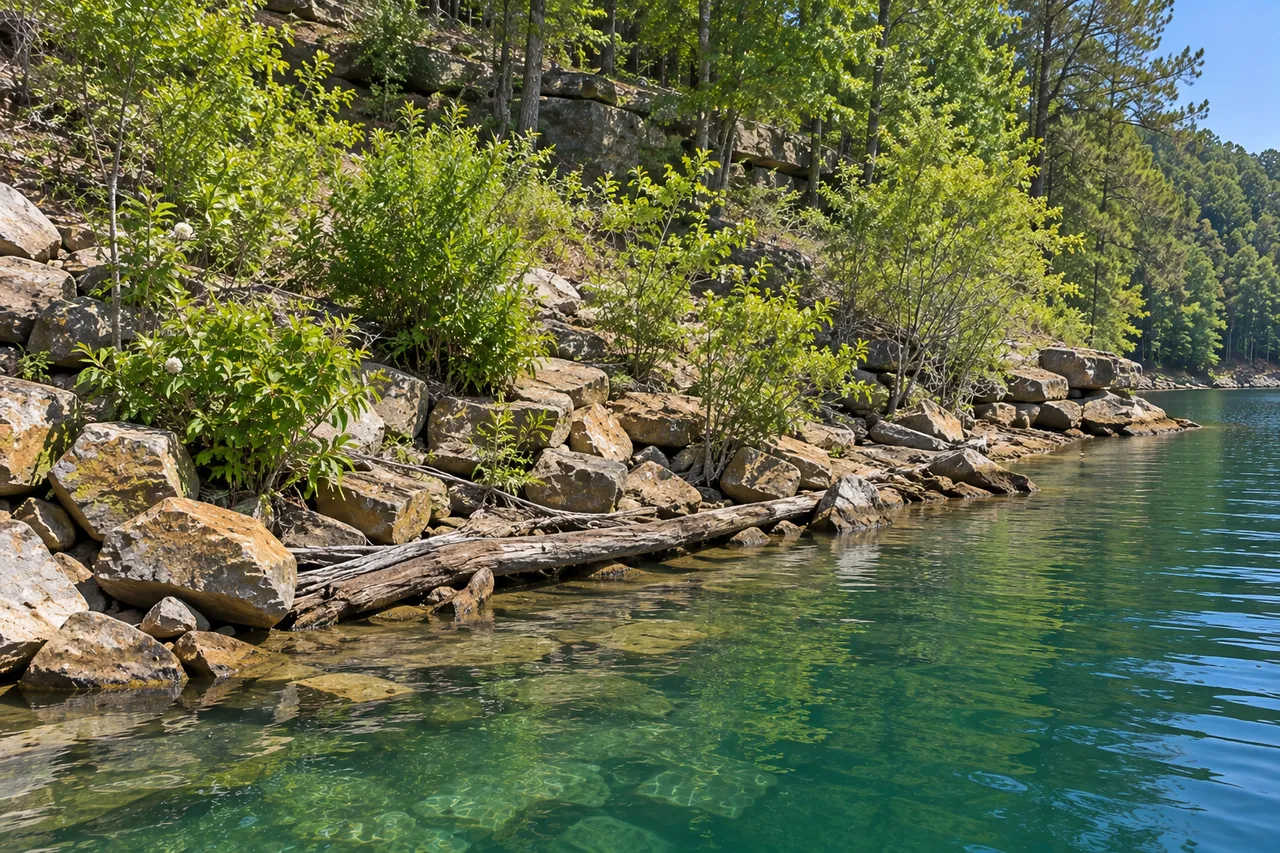
- Expect a different look. An ENS bank is rock with logs and shrubs growing through it, not a clean wall or a uniform stone face.
- Plan for the plants. The 80 percent survival requirement means someone has to care for and possibly replace plants. Settle who does that in the contract.
- Price it on its own terms. We found no published prices for ENS work. Quotes: [PRICE]. It involves more materials and steps than plain riprap, so don't assume a riprap price carries over.
Questions to ask a contractor
- Have you built ENS shorelines on Smith Lake before? Can I see one?
- Do you have Alabama Power's ENS contractor's guide, and will the work follow it?
- Can the job be permitted and built inside the November 1 to March 31 window this year?
- Which quarry is the rock coming from, and in what class mix?
- Where will the logs come from, and what species are they?
- Which plants, how many, and who replaces the ones that die?
These are questions to ask, not claims about any contractor. See who does the work for Alabama's license checks.
Turtle-habitat questions
Can I rebuild my old seawall if my shoreline is habitat?
Alabama Power says that in identified areas, when a seawall needs reconstruction, residents "must use a more natural method to stabilize the shoreline." Ask the shoreline office what that means for your wall before ordering anything.
Can the work be done in summer if I'm not in habitat?
The November 1 to March 31 window in the ENS guide applies to identified potential habitat. For other shorelines, the general guidelines and Corps permit we reviewed set no calendar window for riprap.
Does this apply to docks?
The ENS guide is about shoreline stabilization. Alabama Power's environmental review applies to permit applications generally, so ask the office whether anything about a dock project changes on a habitat shoreline.
Who decides whether my lot is habitat?
Alabama Power, through its shoreline and environmental staff. Call 205-384-7385.
How this site helps
Call (205) 880-2401 or send a request, and we'll pass it to one independent local contractor who works on Smith Lake shorelines. Contractors are responsible for their own licensing, insurance, permits, pricing and warranties.
Sources
- Alabama Power: contractor's guide to enhanced natural stabilization in flattened musk turtle habitat (last modified 2022)
- Alabama Power Shorelines: permitting process and the flattened musk turtle (Sept. 15, 2022)
- Southern Company news release: Smith Lake flattened musk turtle shoreline work
- Alabama Power: Smith Lake residential shoreline guidelines (revised July 15, 2025)
- U.S. Army Corps of Engineers, Mobile District: APCO programmatic general permits
- Alabama Power Shorelines: Smith Lake
Working on a habitat shoreline this winter?
Tell us about your bank or old wall, and we'll pass it to one independent local contractor who works on Smith Lake.