
Seawalls on Smith Lake, Alabama: Repair, Rebuild and the Rules
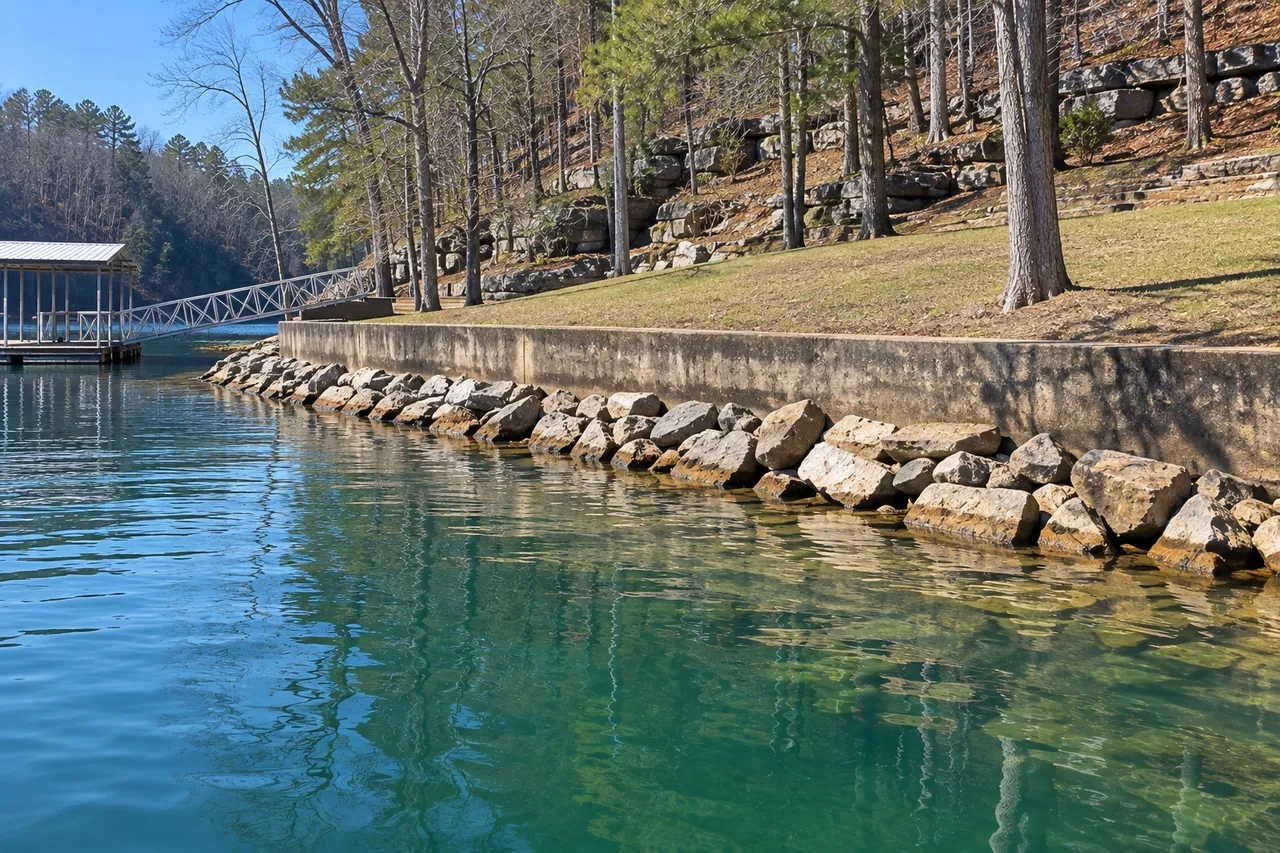
Talk to Smith Lake owners about shoreline work and the word you'll usually hear is "seawall." Seawalls are allowed here, but on Alabama Power's terms: they're weighed case by case, they may need riprap at the base, a replacement can't creep far into the lake, and on turtle-habitat shorelines a failed wall may have to come back as stone and plants. This page covers each of those rules and what to do when your wall starts to go.
Where seawalls stand with Alabama Power
Alabama Power's Smith Lake guidelines (revised July 15, 2025) open their bank stabilization rule this way:
"Rip-rap and natural bank stabilization are the preferred methods of erosion control; however, potential use of seawalls will be evaluated on a case-by-case basis. Approved seawalls should be constructed as close to the existing shoreline as possible for the purpose of preventing erosion of the shoreline bank."
Alabama Power, Smith Lake guidelines, Bank Stabilization
Two things follow. A seawall isn't banned, but it isn't the default either: expect Alabama Power to ask why riprap or natural stabilization wouldn't do the job. And an approved wall is there to stop the bank eroding, so it belongs at the existing shoreline, not out in the lake to gain yard.
The toe riprap rule
The same paragraph ends with a requirement worth knowing before you price a wall:
"Rip-rap may be required at the toe of all new and reconstructed seawalls two feet above the lakebed and two feet out from the bottom of the seawall."
The Corps' programmatic permit for bulkheads says the same thing in its own words: "Riprap will be placed at the base of all bulkheads, where possible." Stone at the base of a vertical wall protects the lakebed in front of it, where waves bouncing off the wall can scour out the footing. When you get a quote for a new or rebuilt wall, ask whether the toe stone is included, how much, and what it adds to the price.
The Corps limits on walls
Seawalls, which the Corps calls bulkheads, fall under the Army Corps' programmatic permit APCO-PGP-05 for Alabama Power reservoirs, and a project-specific verification is needed before the work starts. Its bulkhead terms:
- "Bulkheading is limited to a total project length of 1,000 linear feet and must follow the natural contour of the existing shoreline."
- "New bulkheads shall not extend more than 36 inches waterward from the full pool elevation of the reservoir."
- "Replacement bulkheads shall not extend more than 24 inches waterward from a failed bulkhead."
- Backfill below the ordinary high-water mark is limited to an average of one cubic yard per linear foot.
- The permit "may not be used to regain land lost to erosion."
The 24-inch limit matters if you plan to build a new wall in front of a failing one. It keeps the replacement close to the old line. The permits are currently set to expire January 9, 2027, so confirm their status with Alabama Power when you apply.
Repair, rebuild or replace: which permit and fee
Any seawall work in the lakebed or the flood easement needs an Alabama Power permit; its permits page lists only painting and pressure washing as exceptions.
- Repair of a substantial degree: the $200 General Repair Fee. Alabama Power decides what counts as substantial.
- A new wall, or more length on an existing one: expect the $400 General Construction Fee for new shoreline construction, and confirm with the office.
- A full rebuild of a failed wall: ask the shoreline office how it will be treated, and whether your shoreline is turtle habitat, before you get quotes.
- Work done first and permitted later: the guidelines list a $400 Unauthorized Structure Repair Fee and a $600 Unauthorized Construction Fee.
Backfill rules apply to every option. Alabama Power approves the source and kind of backfill, it can only go to the contour of the natural slope, no debris or foreign material may be used, and no new creosote products are allowed. The permit guide has the full fee list and paperwork.
If your shoreline is turtle habitat
This is the rule that sets Smith Lake apart. Alabama Power says that in areas identified as habitat or potential habitat for the flattened musk turtle, "when seawalls fall into disrepair and reconstruction is required, or when erosion issues need to be addressed, residents in the identified areas must use a more natural method to stabilize the shoreline." That method is enhanced natural stabilization: native rock in a set class mix, logs and native plants, built between November 1 and March 31.
Habitat areas aren't published. Before planning a rebuild, call the Smith Lake Shoreline Management Office at 205-384-7385 and ask whether your shoreline is in an identified area. The turtle-habitat page covers what an ENS shoreline involves.
Signs a seawall needs attention
Walls rarely fail all at once. These are worth photographing, with the date and the lake level, before you call anyone:
- A wall that leans toward the lake, or a top edge that's no longer straight.
- Holes or soft spots opening in the yard just behind the wall, a sign that soil is washing out through it.
- Open joints or cracks, especially with soil stains below them.
- A scoured hollow at the base, often easiest to see in winter when the lake is down.
- Rotting timber, rusted hardware or tie-backs, or broken caps.
Keep people and equipment back from a wall that's moving until it's dealt with. The shoreline erosion page covers banks without walls.
Seawall or riprap?
| Riprap | Seawall | |
|---|---|---|
| Alabama Power's stance | Preferred method | Evaluated case by case |
| New-work permit fee | $400 | $400 |
| Corps limits | Bedding fill below the ordinary high-water mark averages no more than 1 cubic yard per linear foot | New walls within 36 inches of full pool; replacements within 24 inches of the failed wall; 1,000-foot project limit |
| Extra stone | Not applicable | Riprap may be required at the toe |
| In identified turtle habitat | ENS method, November 1 to March 31 | Reconstruction must use a more natural method |
For most eroding banks without a wall, riprap is the simpler permit. Where a wall already holds up a yard or a structure, a repair or a riprap toe may be the realistic route. A contractor and Alabama Power will settle which on site.
Retaining walls higher up the yard
Alabama Power's flood easement on Smith Lake runs to the 522-foot contour. A landscape wall built entirely above that line is outside the lakebed and flood easement that Alabama Power's permit page describes. If a wall would come close to the line, ask Alabama Power where 522 feet falls on your lot before digging, and check with your county and any HOA.
What seawall work costs
We found no published seawall prices for Smith Lake or elsewhere in Alabama, so we don't quote one. Smith Lake seawall quotes: [PRICE]. What moves the price includes the length and height of the wall, whether the old wall has to come out, the toe riprap, and whether the crew works from a barge. Riprap ranges are on the cost page.
Seawall questions
Can I build a new seawall on Smith Lake?
Possibly. Alabama Power evaluates seawalls case by case, and prefers riprap and natural stabilization. An approved wall goes as close to the existing shoreline as possible and needs the Corps' verification too.
Can a new wall go in front of my old one?
The Corps' terms limit a replacement bulkhead to 24 inches waterward of the failed one. Alabama Power still has to approve the work, and in turtle habitat a rebuild may have to use the natural method instead.
Does a seawall repair need a permit?
Repairs of a substantial degree pay the $200 General Repair Fee. Painting and pressure washing are the only work Alabama Power's permits page lists as not needing a permit, so call the office for anything else.
Can I backfill behind the wall to level my yard?
Only to the contour of the natural slope, with backfill Alabama Power approves, and the Corps' terms say its permit can't be used to regain land lost to erosion.
How this site helps
Call (205) 880-2401 or send a request, and we'll pass it to one independent local contractor who works on Smith Lake. Contractors are responsible for their own licensing, insurance, permits, pricing and warranties.
Related pages
Sources
- Alabama Power: Smith Lake residential shoreline guidelines (revised July 15, 2025)
- Alabama Power Shorelines: Permits
- U.S. Army Corps of Engineers, Mobile District: APCO programmatic general permits
- Alabama Power Shorelines: permitting process and the flattened musk turtle (Sept. 15, 2022)
- Alabama Power: contractor's guide to enhanced natural stabilization
Seawall leaning or washing out?
Tell us what the wall is doing, and we'll pass it to one independent local contractor who works on Smith Lake.